- Assembly 94.9%
- Fortran 5.1%
| Filename | Latest commit message | Latest commit date |
|---|---|---|
| doc/assets | ||
| roms | ||
| src | ||
| .gitignore | ||
| readme.md | ||

Custom BIOS / ROM Project
🇬🇧 English
Overview
This project aims to design and implement a PC-compatible BIOS/ROM from scratch, primarily targeted for QEMU emulation, with a strong focus on low-level PC architecture and x86 real-mode assembly programming.
Rather than booting an operating system from disk, the PC starts directly from the ROM into a minimalist graphical interface, using CGA High-Resolution Monochrome (640×200) mode.
The project is intentionally educational, experimental, and minimalist.
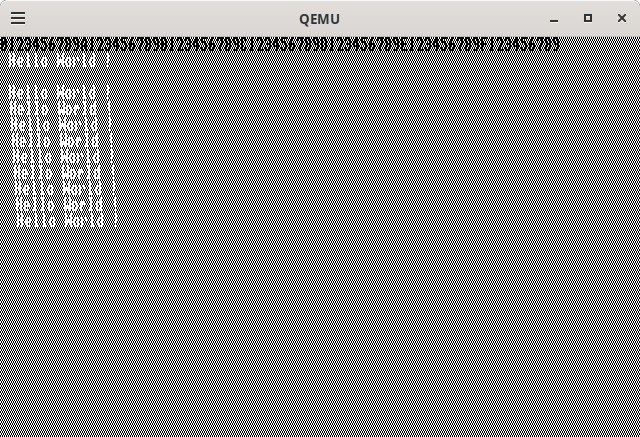
Objectives
-
Write a PC-compatible BIOS from scratch
- No reuse of existing BIOS code
- Minimal but functional implementation
- Compatible with QEMU
- Target architecture: 8086 → 80486
-
Boot directly from ROM
- No DOS, no bootloader, no disk dependency
- Execution starts at reset vector (F000:FFF0)
- ROM is responsible for full system initialization
-
Provide a minimalist graphical interface
- Graphics mode: CGA High-Resolution Monochrome (640×200)
- Direct video memory access
- Custom cursor and basic UI primitives
-
Deep understanding of PC architecture
- CPU reset behavior
- Memory map (RAM, ROM, EBDA, IVT, BDA)
- Interrupt Vector Table
- Hardware initialization (PIC, PIT, keyboard, video)
- Real-mode execution constraints
-
Improve mastery of x86 assembly
- Real-mode x86 assembly (8086-compatible)
- Performance-oriented routines
- Hardware-near programming
- Clear separation between hardware-specific drivers and core logic
Requirements
To build and run this project, the following tools and components are required:
-
NASM (Netwide Assembler) Used to assemble x86 real-mode assembly source files into a raw binary ROM image.
-
QEMU Used as the primary PC emulator for testing and debugging the custom BIOS.
-
QEMU VGA BIOS The standard QEMU VGA BIOS (
vgabios.bin) is required to initialize the VGA hardware, allowing the custom BIOS to rely on a known and stable VGA implementation while focusing on its own core logic.
Build and Run
Compilation
From the project root:
cd src
nasm -f bin boot.asm -o ..\build\bios.bin
This produces a raw BIOS ROM image (bios.bin) suitable for direct execution by QEMU.
Execution
The QEMU VGA BIOS must be copied into a local rom/ directory.
Default locations of vgabios.bin:
Windows
C:\Program Files\qemu\share\vgabios.bin
Linux
/usr/share/qemu/vgabios.bin
You can use an video bios from the 86box's project:
Copy it to: roms/vgabios.bin
Then run QEMU with:
qemu-system-i386 \
  -bios build/bios.bin \
  -device loader,file=roms/vgabios.bin,addr=0xC0000,force-raw=on \
  -device isa-debugcon,chardev=myconsole \
  -chardev stdio,id=myconsole \
  -k be \
  -display sdl
This command:
- Loads the custom BIOS as the system ROM
- Injects the VGA BIOS at 0xC0000
- Redirects debug output to the console
- Displays graphics using SDL
Non-Goals
- Full IBM BIOS compatibility
- Protected mode or modern CPUs
- Advanced OS services
- DOS or legacy OS support
This is a learning and exploration project, not a drop-in BIOS replacement.
🇫🇷 Français
Présentation
Ce projet consiste à concevoir et développer un BIOS/ROM PC compatible entièrement écrit “from scratch”, destiné principalement à l’émulation QEMU, avec pour objectif principal l’apprentissage approfondi de l’architecture PC et de la programmation assembleur x86 en mode réel.
Au lieu de charger un système d’exploitation depuis un disque, le PC démarre directement depuis la ROM vers une interface graphique minimaliste, utilisant le mode CGA Haute Résolution Monochrome (640×200).
Le projet est volontairement éducatif, expérimental et minimaliste.
Objectifs
-
Écrire un BIOS PC depuis zéro
- Aucun code BIOS existant réutilisé
- Implémentation minimale mais fonctionnelle
- Compatible avec QEMU
- Architecture ciblée : 8086 jusqu’au 486
-
Démarrer directement depuis la ROM
- Sans DOS, sans bootloader, sans disque
- Exécution depuis le vecteur de reset (F000:FFF0)
- La ROM initialise entièrement la machine
-
Fournir une interface graphique minimaliste
- Mode graphique : CGA Hi-Res Monochrome (640×200)
- Accès direct à la mémoire vidéo
- Curseur personnalisé et primitives graphiques simples
-
Approfondir la compréhension de l’architecture PC
- Séquence de reset CPU
- Cartographie mémoire (RAM, ROM, EBDA, IVT, BDA)
- Table des vecteurs d’interruptions
- Initialisation matérielle (PIC, PIT, clavier, vidéo)
- Contraintes du mode réel
-
Perfectionner la maîtrise de l’assembleur
- Assembleur x86 en mode réel (compatible 8086)
- Routines optimisées pour la performance
- Programmation proche du matériel
- Séparation claire entre cœur du BIOS et drivers matériels
Pré-requis
Pour compiler et exécuter ce projet, les outils suivants sont nécessaires :
-
NASM (Netwide Assembler) Utilisé pour assembler le code x86 en mode réel et générer une image ROM binaire brute.
-
QEMU Utilisé comme émulateur PC principal pour tester et déboguer le BIOS personnalisé.
-
BIOS VGA de QEMU Le BIOS VGA standard de QEMU (vgabios.bin) est utilisé pour initialiser le matériel vidéo, ce qui permet au projet de se concentrer sur le développement du BIOS sans réimplémenter la logique VGA complète.
Compilation et exécution
Compilation
Depuis la racine du projet :
cd src
nasm -f bin boot.asm -o ..\build\bios.bin
Cette commande génère une image BIOS brute (bios.bin) directement exécutable par QEMU.
Exécution
Le BIOS VGA de QEMU doit être copié dans un dossier local rom/.
Emplacements par défaut de vgabios.bin :
Windows
C:\Program Files\qemu\share\vgabios.bin
Linux
/usr/share/qemu/vgabios.bin
Vous pouvez aussi utiliser un bios video du projet de 86box
À copier vers : roms/vgabios.bin
Puis lancer QEMU avec la commande suivante :
qemu-system-i386 \
  -bios build/bios.bin \
  -device loader,file=roms/vgabios.bin,addr=0xC0000,force-raw=on \
  -device isa-debugcon,chardev=myconsole \
  -chardev stdio,id=myconsole \
  -k be \
  -display sdl
Cette commande :
- Charge le BIOS personnalisé comme ROM système
- Injecte le BIOS VGA à l’adresse 0xC0000
- Redirige les messages de debug vers la console
- Affiche l’interface graphique via SDL
Hors périmètre
- Compatibilité BIOS IBM complète
- Mode protégé ou CPU modernes
- Services système avancés
- Support DOS ou OS legacy
Ce projet est avant tout un laboratoire d’apprentissage et d’exploration, et non un BIOS de production.
Status
🚧 Work in progress Designed for experimentation, learning, and documentation.