| Filename | Latest commit message | Latest commit date |
|---|---|---|
| .. | ||
| manifest.xml | ||
| MSDOS320-DISK1.json | ||
| MSDOS320-DISK2.json | ||
| MSDOS320-DISK3-PROGREF1-thumb.jpg | ||
| MSDOS320-DISK3-PROGREF1.jpg | ||
| MSDOS320-DISK3-PROGREF1.json | ||
| MSDOS320-DISK4-PROGREF2.json | ||
| README.md | ||

MS-DOS 3.20
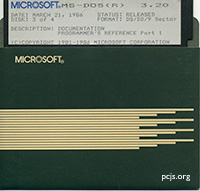
The MS-DOS 3.20 floppies in the PCjs collection had a printed date of March 21, 1986 (see the photo below).
However, all the files on Disks 1 and 2 are timestamped 7-07-86 12:00p.
Surprisingly Bad Bug in MS-DOS 3.20
If you attempt to boot MS-DOS 3.20 on an IBM PC Model 5150 (with either an MDA or CGA video card), the machine will appear to crash after printing the first character.
When MS-DOS 3.20 prints characters to the screen, it uses this code:
0287:1FA8 CD29            INT      29                   ;history=7
0070:017A 50              PUSH     AX                   ;history=6
0070:017B 56              PUSH     SI                   ;history=5
0070:017C 57              PUSH     DI                   ;history=4
0070:017D 55              PUSH     BP                   ;history=3
0070:017E B40E            MOV      AH,0E                ;history=2
0070:0180 B307            MOV      BL,07                ;history=1
0070:0182 CD10            INT      10
AX=0E43 BX=0B07 CX=0010 DX=0000 SP=0862 BP=36FE SI=00D3 DI=000B
SS=0287 DS=0287 ES=0287 PS=F012 V0 D0 I0 T0 S0 Z0 A1 P0 C0
whereas MS-DOS 3.30 uses this code:
022F:222E CD29            INT      29                   ;history=10
0070:069E 50              PUSH     AX                   ;history=9
0070:069F 56              PUSH     SI                   ;history=8
0070:06A0 57              PUSH     DI                   ;history=7
0070:06A1 55              PUSH     BP                   ;history=6
0070:06A2 53              PUSH     BX                   ;history=5
0070:06A3 B40E            MOV      AH,0E                ;history=4
0070:06A5 B700            MOV      BH,00                ;history=3
0070:06A7 B307            MOV      BL,07                ;history=2
0070:06A9 CD10            INT      10                   ;history=1
MS-DOS 3.20 doesn't clear the BH register before calling INT 0x10 Video BIOS function 0x0E, and the Model 5150 Video BIOS uses the BH register to select the video page, so when BH contains garbage (0x0B in the above example), it prints characters off-screen, where they can’t be seen.
As a result, the machine hasn't technically "crashed", but it's printing characters where they can't be seen, making the machine more or less unusable.
Starting with the IBM PC Model 5160, Video BIOS function 0x0E ignores BH and always use the current page.
Microsoft must not have tested MS-DOS 3.20 on any 5150 machines, or if they did, those machines must have contained
upgraded video cards, such as the EGA, which provided their own Video BIOS. This bug was fixed in MS-DOS 3.21,
but that release apparently wasn't made available until almost a year later (MS-DOS 3.21 files are timestamped
5-01-87 12:00a).
MS-DOS 3.20 Photos
Here's what one of the MS-DOS 3.20 diskettes looked like.
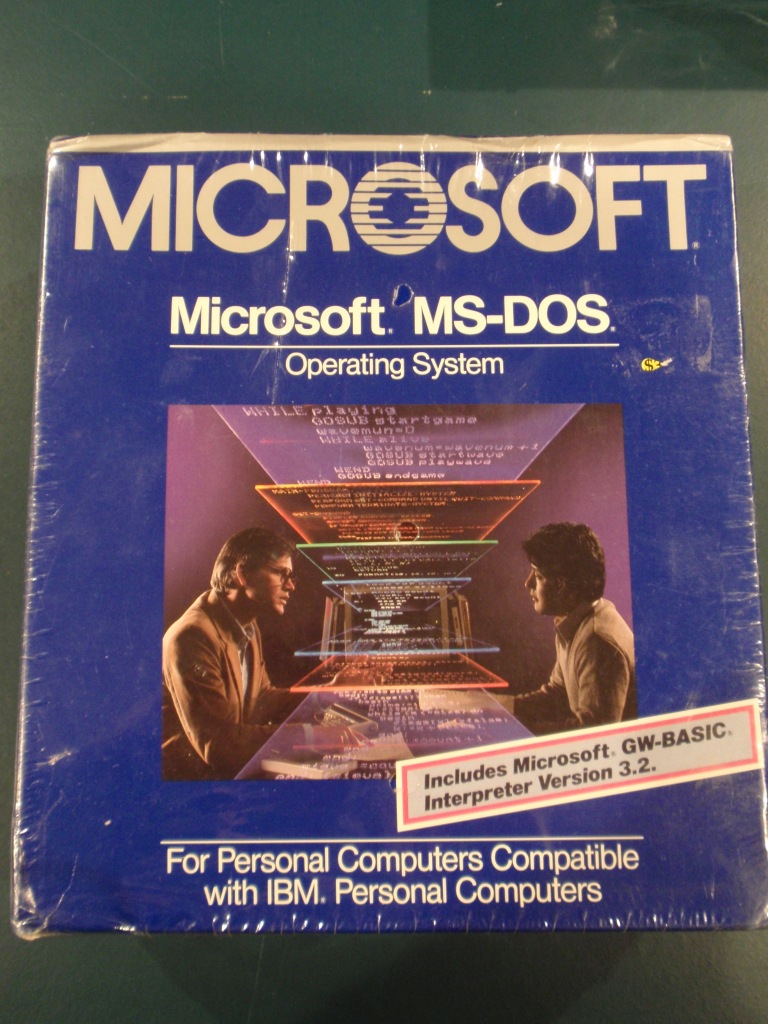
And the box, courtesy of www.oldcomputermuseum.com.